
AdaptSR: Low-Rank Adaptation for Efficient and Scalable Real-World Super-Resolution
Authors: Cansu Korkmaz, Nancy Mehta, Radu Timofte
Venue: arXiv preprint, 2025
Overview
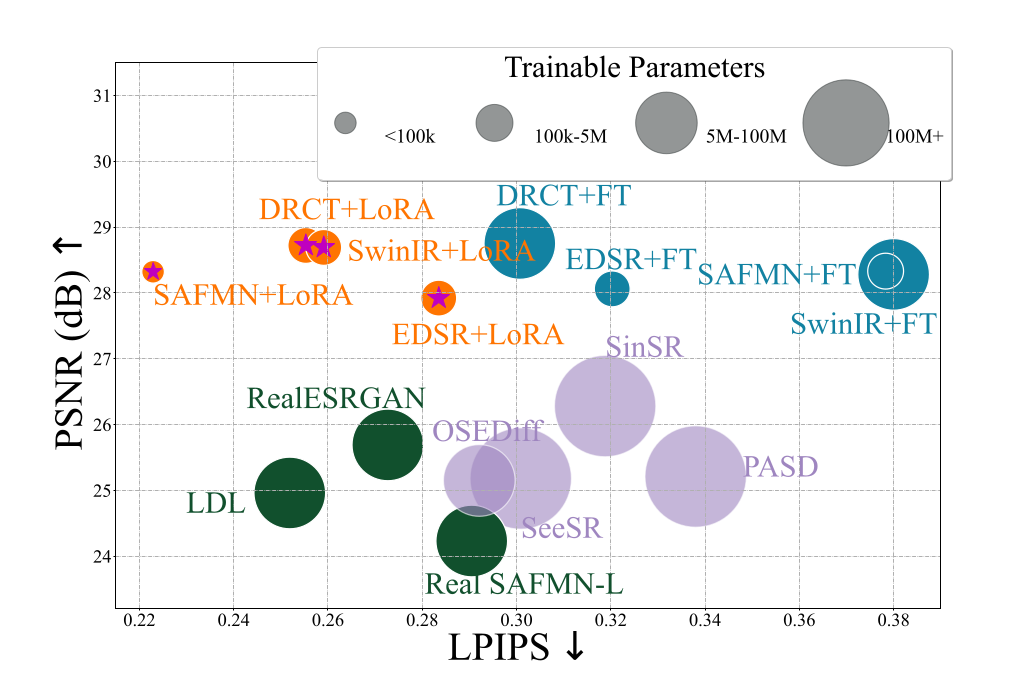
Super-resolution (SR) models trained on bicubic downsampling perform poorly on real-world images, where degradations are complex and unknown. Rather than resorting to unstable GAN training or computationally expensive diffusion models, AdaptSR repurposes bicubic-trained SR backbones for real-world SR by inserting lightweight low-rank adaptation (LoRA) layers. Only these LoRA layers are updated during adaptation, while the pretrained backbone stays frozen, so the model captures domain-specific corrections without adding any inference-time cost — the adapted layers merge seamlessly back into the backbone after training.
Key Contributions
- Architecture-aware low-rank adaptation strategy that repurposes bicubic-trained SR models for real-world degradations
- Outperforms GAN- and diffusion-based real SR methods by up to 4 dB in PSNR and 2% in perceptual scores
- Trains roughly 92% fewer parameters than competing methods, enabling adaptation in minutes on modest hardware, with zero added inference cost